
CHILD Framework
A Curious Human Instinct Lives Deep in all of Us — and the Creative Thinking Framework that finally names it.
Five traits. One repeating loop. A name for what you already do.
Not a personality type. Five trainable traits that chain into a loop — and a name for the sequence school never gave you.
Scroll ↓
The short version
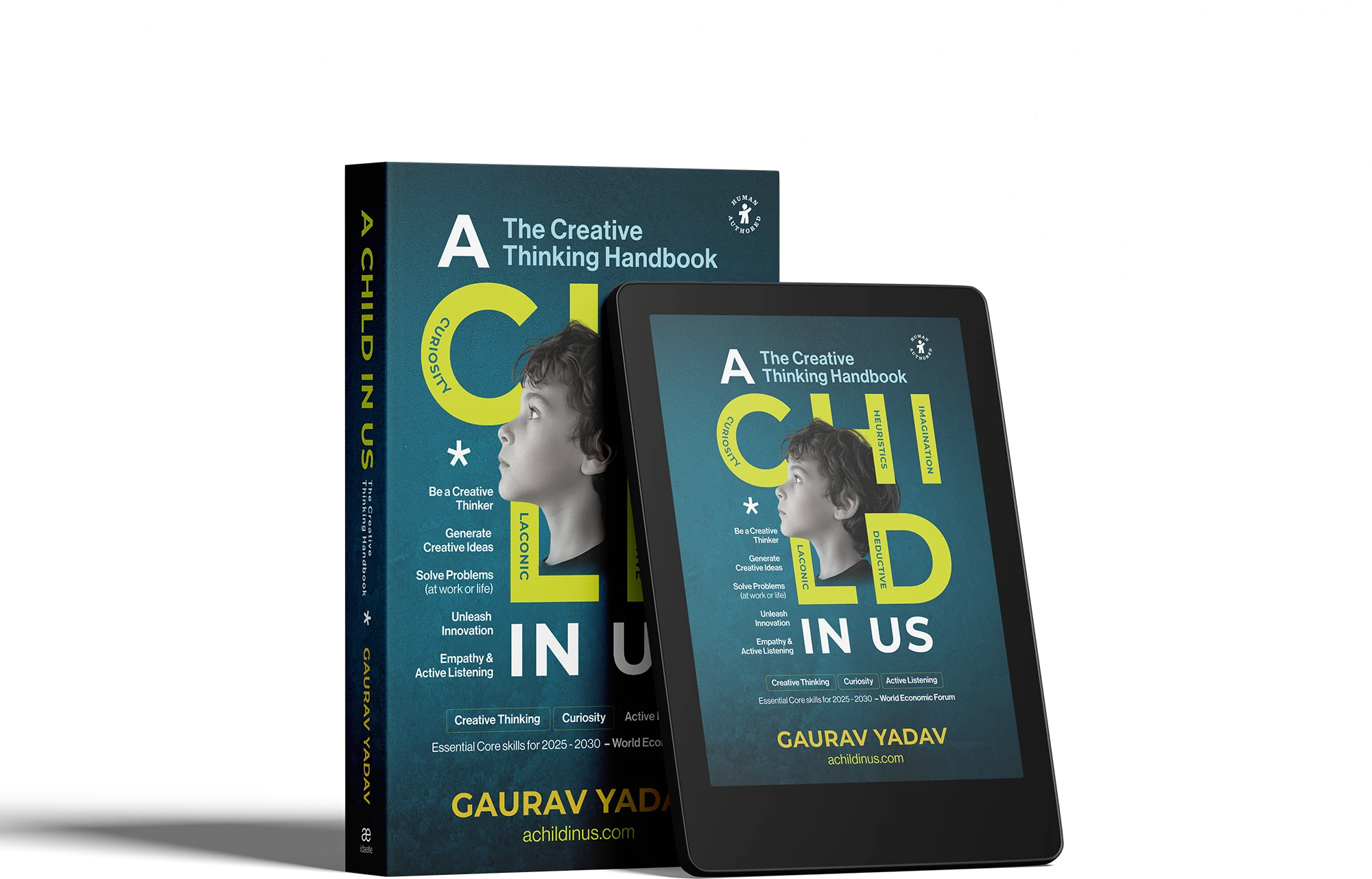
The CHILD Framework is a five-trait model of creative thinking developed by Designer, Author, Strategist Gaurav Yadav. CHILD is an acronym for Curiosity, Heuristics, Imagination, Laconic, and Deductive — five cognitive traits that operate as a repeating loop rather than a linear process. The framework was introduced in A CHILD in Us: The Creative Thinking Handbook (2025).
Unlike personality instruments, which sort people into fixed types, the CHILD Framework treats all five traits as trainable capacities that vary in strength within the same person and change with practice.
The method was never lost. It was overwritten.
Watch any child meet a problem they’ve never seen, and the same sequence runs every time.
It starts with raw curiosity — what if?, why not? — the question asked without checking whether it’s allowed.
That question drives exploration. Testing edges. Finding what’s already known and borrowing it.
Exploration sparks imagination — not daydreaming, but building a mental model of something that doesn’t exist yet.
Imagination needs expression, and a child’s expression is brutally efficient. No hedging. No preamble. The point, delivered.
And it resolves into reasoning. If this, then that. Cause and effect, assembled from evidence.
Then formal education arrives and rewards a different sequence: memorise, apply, verify. All useful. All incomplete. The original loop doesn’t disappear — it goes unnamed, and what goes unnamed goes unpractised.
This framework doesn’t teach you to think like a child. It gives the thing you already do a name, so you can do it on purpose.
The five traits
- CCuriosity
- HHeuristics
- IImagination
- LLaconic
- DDeductive
Explored individually below.
The five traits
The seed
uriosity
Asking the question nobody asked.
The seed of creative thinking.
Curiosity, in the CHILD Framework, is the disciplined practice of asking the question that reframes the problem — not asking more questions, but asking the one that changes what problem you’re solving.
Every idea starts as a question someone was willing to ask out loud. Curiosity is the habit of asking one more.
You’re running low on Curiosity when
- your first instinct on a new brief is to reach for what worked last time
- you can state the problem but not why it’s a problem
- your questions all begin with “how” and never with “why”
The shortcut
euristics
Borrowing patterns that already work.
The art of simplifying complexity.
Heuristics, in the CHILD Framework, are the transferable patterns expert problem-solvers reuse instead of starting from scratch — the difference between solving a problem and recognising one.
You have solved something like this before, or someone has. Heuristics is knowing which pattern to reach for.
You’re running low on Heuristics when
- every project feels like starting over
- you solve the same class of problem repeatedly without it getting faster
- you can’t name three patterns from outside your industry
The fuel
magination
Seeing what isn’t there yet.
The fuel for creativity and innovation.
Imagination, in the CHILD Framework, is the structured exploration of what does not yet exist — generating possibility space deliberately rather than waiting for it.
The ability to hold a version of the world that does not exist yet, and describe it clearly enough to build.
You’re running low on Imagination when
- your options are always variations on one idea
- you evaluate before you generate
- “realistic” enters the conversation in the first ten minutes
The edge
aconic
Cutting until only the essential survives.
The power of precision.
Laconic, in the CHILD Framework, is the practice of reduction under pressure — cutting an idea until only what’s load-bearing remains, because unclear ideas don’t get adopted.
Most ideas fail because they are too big to explain. Laconic is the discipline of removing until it lands.
You’re running low on Laconic when
- your deck needs you standing next to it
- you explain the idea differently every time
- people nod and then ask what you meant
The anchor
eductive
Building logic others can follow.
The logic others can follow.
Deductive, in the CHILD Framework, is the construction of reasoning others can follow, audit, and build on — the trait that turns a good idea into a repeatable method.
An idea only travels if the reasoning is visible. Deductive is the work of making the path checkable.
You’re running low on Deductive when
- your best ideas can’t be handed off
- you know it’s right but can’t show why
- the work doesn’t survive your absence
How the five chain together
Curiosity opens the problem. Heuristics narrows the search. Imagination expands the options. Laconic cuts to the essential. Deductive makes it transferable.
Then it runs again. Each pass, the question gets sharper — because you now know something you didn’t when you asked it the first time.
Most frameworks are pipelines: in one end, out the other. CHILD Framework is a loop, which is why it works on problems that change while you’re solving them.
A common failure mode: teams over-index on the traits their culture rewards. Engineering-led teams run strong Deductive and weak Imagination. Agency teams run strong Imagination and weak Laconic. The loop breaks at whichever trait nobody is being paid to have.
CHILD Framework and other creative thinking frameworks
CHILDBuilding creative capability in a personFive traits, loopingYou want to know why your thinking stalls and train the specific gap
CHILD works by isolating which of the five traits is actually missing rather than prescribing one workshop for everyone. A team weak on Imagination needs a different intervention than a team weak on Laconic — this framework tells you which one you’re dealing with before you book anything.
Design ThinkingRunning a user-centred projectFive phases, sequentialYou have a team, a user, and a defined project
Design Thinking assumes the problem is already framed and a user is already identified. It excels at turning that framing into a shipped solution through empathize-define-ideate-prototype-test, but it has nothing to say about why a team’s thinking stalls before the project even starts.
SCAMPERGenerating variations on something existingSeven prompts, checklistYou have a product to improve, not a problem to define
SCAMPER’s seven prompts — Substitute, Combine, Adapt, Modify, Put to another use, Eliminate, Reverse — are fastest when there’s a concrete artefact already on the table. It offers nothing for problems that haven’t been defined yet.
Six Thinking HatsStructuring group discussionSix modes, facilitatedYou’re in a meeting where everyone argues the same way
Each hat isolates one mode of thinking — facts, emotion, caution, optimism, creativity, process — so a group stops arguing at cross purposes. It manages a conversation well; it doesn’t build anyone’s underlying capability once the meeting ends.
TRIZResolving technical contradictionsPattern libraryThe problem is engineering and the contradiction is physical
Built from patterns found across hundreds of thousands of patents, TRIZ is unmatched for genuine engineering contradictions — more torque without more weight, more strength without more material. Outside engineering, its pattern library has little to offer.
Design SprintValidating a product idea with a team in one weekFive days, fixed sequenceYou have a team and need a tested decision by Friday
Design Sprint compresses months of product debate into five fixed days — map, sketch, decide, prototype, test — ending in a real user-tested answer. It says nothing about the thinking quality inside Tuesday’s sketching hour; a team fluent in CHILD tends to produce sharper sketches to sprint with in the first place.
Lateral ThinkingEscaping a single, fixed pattern of thoughtProvocation techniques, no sequenceYou’re stuck on one obvious answer and need to break the pattern in the moment
Edward de Bono’s provocation techniques — random entry, po, movement — are unmatched for jolting a mind sideways when it’s locked onto a single obvious solution. But the method treats every block the same way: it has no way to diagnose which underlying capacity is actually missing before or after the jolt, so the same provocation gets applied whether the problem is a lack of curiosity, imagination, or something else entirely.
Mind MappingExternalising and organising associative thoughtRadial diagram, one central nodeYou already have a mass of ideas in your head and need to see them all at once
Tony Buzan’s radial notation mirrors how associative memory actually branches, and as a capture tool it’s genuinely fast — nothing beats it for getting what’s already in someone’s head onto a page. But it’s a notation system, not a training system: it records what a person already thinks. It has nothing to say about why their thinking stalled before the map even started.
The honest distinction: Design Thinking, SCAMPER, and Six Thinking Hats are process tools — you run them on a project. CHILD Framework is a capability model — you run it on yourself. They’re complementary. A team that can’t imagine won’t get value from a Design Thinking workshop, and CHILD Framework tells you that before you book the room.
Frequently asked
What does CHILD stand for in the CHILD Framework?
CHILD is an acronym for Curiosity, Heuristics, Imagination, Laconic, and Deductive — the five cognitive traits the framework identifies as the components of creative thinking.
Who created the CHILD Framework?
Gaurav Yadav, a Designer, Author, Strategist, introduced it in A CHILD in Us: The Creative Thinking Handbook (2025).
Is the CHILD Framework a personality test?
No. Personality instruments sort people into stable types. The CHILD Framework measures five trainable capacities that shift with practice. Your CHILDex profile is a snapshot, not a label.
What does "Laconic" mean in the CHILD Framework?
Laconic means saying the most with the least. In the framework it’s the trait of reduction — cutting an idea until only what’s essential remains, because ideas that can’t be stated simply don’t get adopted.
How is CHILD different from Design Thinking?
Design Thinking is a process you run on a project. CHILD is a capability model you run on yourself. Design Thinking tells you what to do next; CHILD tells you which of your own thinking traits is the bottleneck.
Can creative thinking actually be learned?
Yes. The framework’s premise is that creative thinking is a set of observable, repeatable behaviours — not an inherited trait. Every one of the five traits can be practised deliberately.
How long does it take to see results?
Most readers report a shift within one project cycle. The traits are already present; naming them is what makes them deliberate.
Is there a free way to try it?
Yes — CHILDex measures all five traits in about six minutes, free, no signup required to see your result.
Can teams use the CHILD Framework?
Yes. It’s often more useful at team level than individual level, because teams develop collective blind spots — usually in whichever trait the team’s culture doesn’t reward.
Where can I read the full framework?
A CHILD in Us: The Creative Thinking Handbook covers all five traits with exercises, cases, and the CHILD Loop in full.
How is CHILD different from Lateral Thinking?
Lateral Thinking gives you a technique to break a specific mental block in the moment. CHILD diagnoses which of five underlying traits is weak in the first place, so the right kind of practice — not just the right provocation — gets applied.
How is CHILD different from Mind Mapping?
Mind Mapping is a notation tool for organising ideas you already have. CHILD is a capability model for building the thinking that produces those ideas — the two aren’t competitors so much as different stages of the same process.
See where your own five stand
CHILDex measures all five traits in about six minutes, free, no signup required. Or read A CHILD in Us: The Creative Thinking Handbook for the full framework with exercises and cases.