
A Curious Human Instinct Lives Deep, a Reflex in all of Us.
The world needs creative thinkers. You were born one.
The CHILD Creative Thinking Framework
Creative thinking can be measured.
Not whether you're creative — that question is useless. Which of the five you run on, and which one is quietly holding the rest back.
The Creative Thinking Handbook
And measured skills can be trained.
Nothing was lost. It just stopped being called thinking.
A CHILD in Us is the handbook for all five traits — one chapter each, real exercises, and a loop you can run on Monday's actual problem.
The five traits: Curiosity, Heuristics, Imagination, Laconic, Deductive.

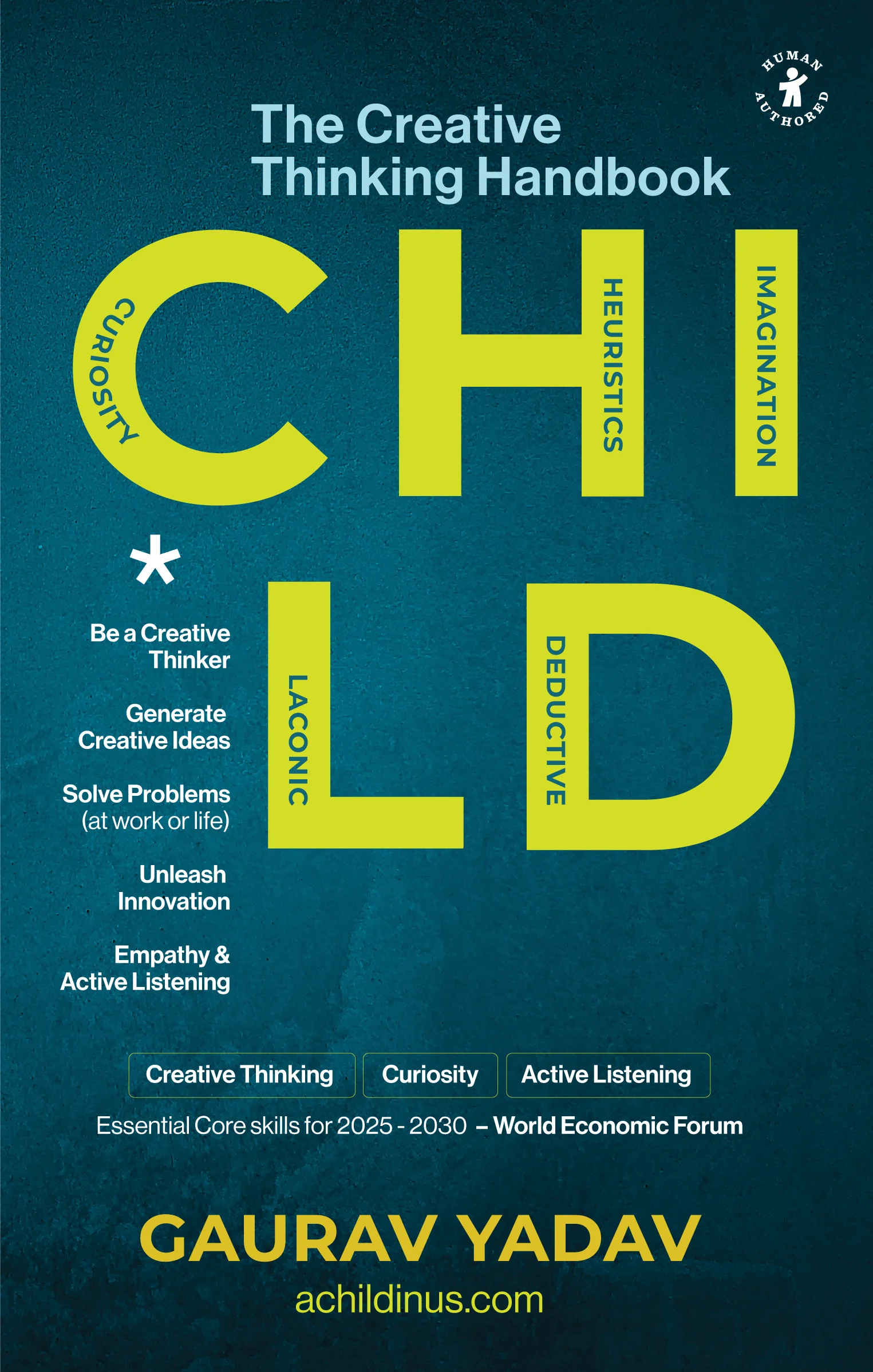

A CHILD in Us: The Creative Thinking Handbook by Gaurav Yadav.
Scroll ↓
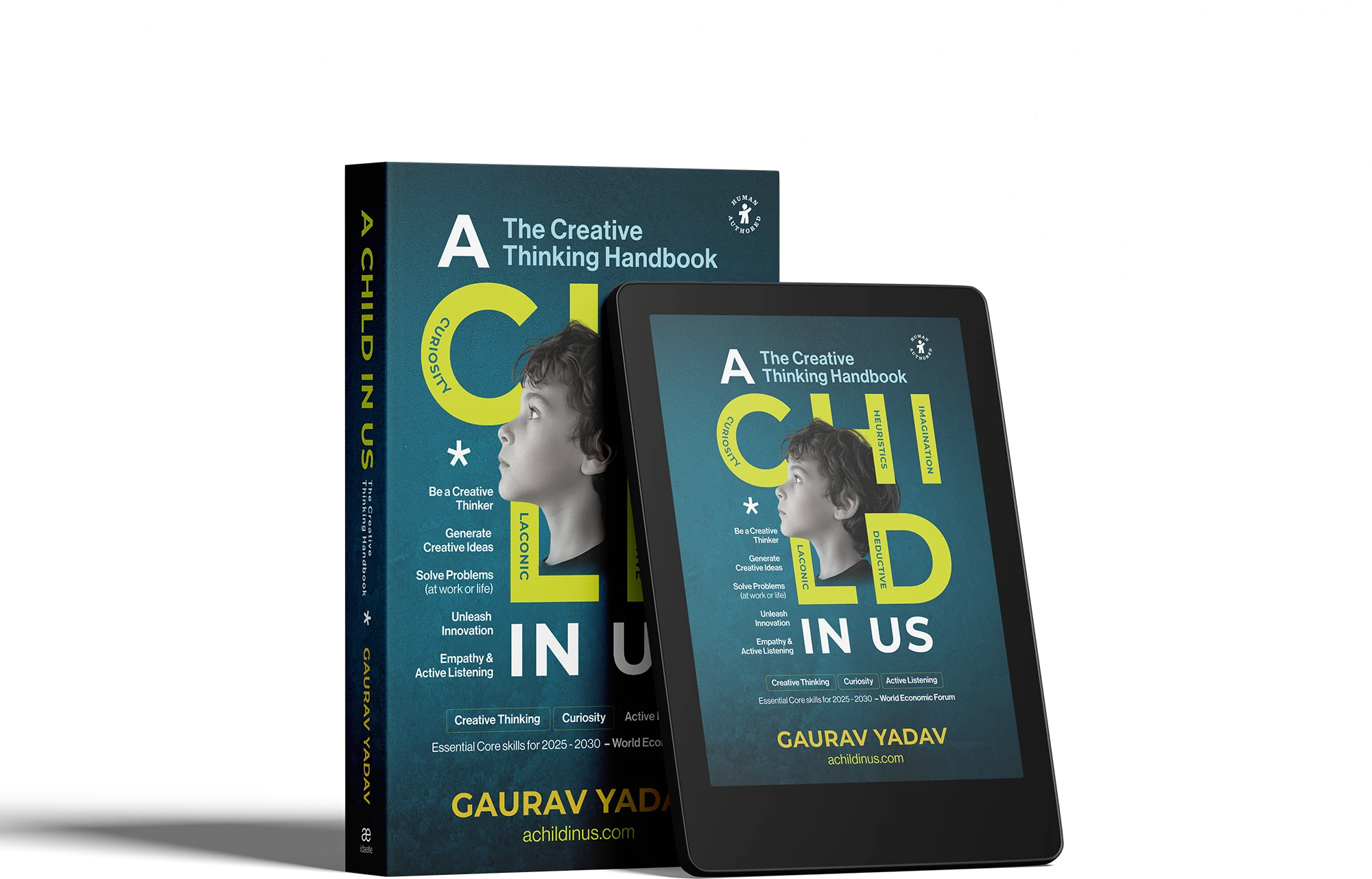
A CHILD in Us — The Creative Thinking Handbook. Paperback and eBook, wherever you read.
Read what's inside








Endorsed by

I am the world’s fastest reader, and just finished reading A CHILD in Us. As an expert on accelerated learning I highly recommend this book as an excellent source for unleashing your Creativity and Imagination.
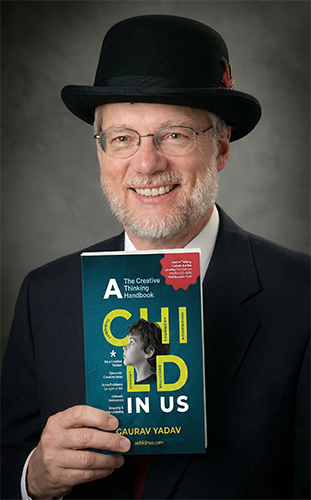
Stay ahead of AI, and everyone else, in your career. Read this book. This is a practical, current guide to the challenges we face today. Plus it’s downright fun and enjoyable to read.
What readers say onAmazon
All reviews- Shalabh Yadav5 months ago
5 out of 5 starsVerified purchase
A refreshing and inspiring read!
A CHILD in Us: The Creative Thinking Handbook beautifully reminds us how much of our natural creativity we leave behind, and how simply it can be picked back up.
Read more — A refreshing and inspiring read!, review on Amazon - Puneeta5 months ago
5 out of 5 starsVerified purchase
Value for money
It’s a must read, a very nice way of reminding us how the child in us shows up with different personalities at different times.
Read more — Value for money, review on Amazon - Kindle Customer6 months ago
5 out of 5 starsVerified purchase
Good Read!
The book is an easy, enjoyable read. Author Gaurav Yadav brings a new perspective by integrating different ideas into one usable framework.
Read more — Good Read!, review on Amazon - Akshay6 months ago
5 out of 5 starsVerified purchase
Good read!
I just finished reading A CHILD in Us. It felt more like listening to Gaurav than reading — the writing is conversational and easy to stay with.
Read more — Good read!, review on Amazon - c. Tandon6 months ago
5 out of 5 starsVerified purchase
An engaging book to unlock creative thinking
The book highlights curiosity, imagination, empathy and active listening, and makes a case for treating them as skills rather than traits.
Read more — An engaging book to unlock creative thinking, review on Amazon - Amazon Customer6 months ago
5 out of 5 starsVerified purchase
Make A Difference!
A good, easy, quick read. For the out-of-the-box mind it is encouraging and supportive; for the change-begins-with-me mind it is a practical start.
Read more — Make A Difference!, review on Amazon - Dr. K7 months ago
5 out of 5 starsVerified purchase
Enjoyed reading it!
Good, quick read. It wasn’t too heavy or complicated, which I appreciated. It’s mostly about looking at familiar things differently.
Read more — Enjoyed reading it!, review on Amazon - Rajiv7 months ago
5 out of 5 starsVerified purchase
Reclaiming curiosity as a competitive advantage in the AI era
I thoroughly enjoyed reading A CHILD in Us by Gaurav Yadav. The book makes a clear argument for why curiosity is the skill that compounds.
Read more — Reclaiming curiosity as a competitive advantage in the AI era, review on Amazon
Ranked
AmazonBest Sellers — Top 100 Paid, three categories at once.
- #45Creativity Self-Help
- #61Business Decision-Making
- #83Motivational Business Management
Shelved beside Twyla Tharp, The Creative Habit, Gary Keller, The One Thing, John Lewis Gaddis, On Grand Strategy.Amazon.com Kindle Store, Top 100 Paid — December 2025
Analytical thinking has been taught for a hundred years.Creative thinking has never been taught at all.
The World Economic Forum's Future of Jobs Report 2025 ranks creative thinking among the top five core skills employers need — and among the fastest-rising skills through 2030.
Now name the class where you learned it.
Every one of us was handed a method for analysis: outline it, break it down, show your work. Nobody was handed a method for the other thing. So creativity got filed under talent — something you either have or you envy.
That filing error is the most expensive mistake in modern professional development. Creative thinking has a structure. It's observable. It's repeatable. And it's already running inside you.
The Framework
Five traits. One loop. Infinite problems.
- CuriosityThe seed of creative thinking.Every idea starts as a question someone was willing to ask out loud. Curiosity is the habit of asking one more.The seed
- HeuristicsThe art of simplifying complexity.You have solved something like this before, or someone has. Heuristics is knowing which pattern to reach for.The shortcut
- ImaginationThe fuel for creativity and innovation.The ability to hold a version of the world that does not exist yet, and describe it clearly enough to build.The fuel
- LaconicThe power of precision.Most ideas fail because they are too big to explain. Laconic is the discipline of removing until it lands.The edge
- DeductiveThe logic others can follow.An idea only travels if the reasoning is visible. Deductive is the work of making the path checkable.The anchor
The CHILD Framework is a five-trait model of creative thinking developed by Designer, Author, Strategist Gaurav Yadav. CHILD is an acronym for Curiosity, Heuristics, Imagination, Laconic, and Deductive — five cognitive traits that operate as a repeating loop rather than a linear process. The framework was introduced in A CHILD in Us: The Creative Thinking Handbook (2025).
Watch a four-year-old meet a locked box. Why is it locked? (Curiosity)The other one opened with a twist. (Heuristics) Maybe there's treasure.(Imagination) It's stuck. (Laconic) So I need something thin. (Deductive) That's not cute. That's a complete problem-solving architecture, running before the child can read.
Explore the CHILD FrameworkThe Book
Born from years of observation. Built for a lifetime of use.
A CHILD in Us: The Creative Thinking Handbook is a systematic deconstruction of how innovation actually happens — built through design anthropology rather than motivational theory.
What's inside
- 19 chapters across 5 sections — one section per trait — plus an introduction and epilogue
- Real cases: Dyson’s 5,126 prototypes, Netflix’s pivot, Disney’s imagineering, Toyota’s lean system
- The CHILD Loop — how the traits chain into a repeatable method
- Prompts designed to make you think, not nod
What it isn't: a personality test, a motivational read, or 300 pages of research summary.
Which of the five is your strongest?
And which one is quietly costing you?
CHILDex measures all five traits and returns your Child Index — a profile, not a score out of ten. It takes about six minutes, costs nothing, and needs no signup to see your result.
Most people find their weakest trait is the one they never suspected.
Take the CHILDexBuilt for people who get paid to solve things nobody has solved yet



You lead innovation
— and ‘let’s brainstorm’ keeps producing the same three ideas.



You lead people
— and you can’t coach a skill you were never taught yourself.



You’re building what’s next
— a company, a career, a curriculum, in a decade that keeps changing the brief.



You solve the hard ones
— the problems that arrive without precedent, where analysis runs out.
Written for
- Innovators
- Creative professionals
- Designers
- Managers & team leaders
- C-suite & senior executives
- Educators
- Entrepreneurs
- Students
- Young adults
- Engineers & IT professionals
- Analysts
- Policy makers
- Lifelong learners
The framework, in rooms
Workshops, lecture halls, book fairs — where the CHILD Framework has been taught and talked about.
Taught at the Illuminate Workshop — Scale Your Idea into Business within a Day, organised by E-Cell, IIT Bombay, held at NMAMIT, Nitte, Udupi, Karnataka.
Featured in The Indian Express (Delhi edition) and exhibited at the New Delhi World Book Fair 2026, Bharat Mandapam.