
Compare
A Child in Us vs. The Creative Act
If Rick Rubin's The Creative Act restored your sense that creativity is something larger than you to tune into, but left you without a way to actually practise it on Monday morning, this comparison is for you.
The Creative Act
Rubin treats creativity as a force that already exists in the world, waiting to be received — the artist's job is to stay open, present, and unattached to outcome. Structured across hundreds of short meditations rather than a linear argument, the book's case is spiritual and dispositional. It's a book about openness.
A Child in Us
The CHILD Framework is a five-trait model of creative thinking developed by design anthropologist Gaurav Yadav. CHILD is an acronym for Curiosity, Heuristics, Imagination, Laconic, and Deductive — five cognitive traits that operate as a repeating loop rather than a linear process. The framework was introduced in A CHILD in Us: The Creative Thinking Handbook (2025). The CHILD Framework is a five-part loop, not a philosophy — built from what children's minds do differently, not from how creativity feels when it's flowing. It's a book aboutmechanism.
| The Creative Act | A Child in Us | |
|---|---|---|
| Core unit | Meditation and principle | Framework and loop |
| Grounded in | Spiritual practice, studio experience | Design anthropology, child observation |
| Actionability | Shift in disposition | Structured process (CHILD loop) |
| Assessment tool | None | CHILDex (free) |
Where The Creative Act wins
For someone whose block is reverence, not process — who has grown too calculating, too outcome-obsessed, too closed off from noticing — Rubin's voice restores something a framework can't reach. The Creative Act is the better book for remembering why making things matters at all, before any method is useful.
Where A Child in Us wins
Once openness isn't the blocker — once someone feels the pull to create but can't tell which specific habit of mind is holding their work back — The Creative Act has little more to offer; it was never built to diagnose. CHILD is built for exactly that: a structured five-part loop with a free self-assessment to show where someone's thinking actually stands.
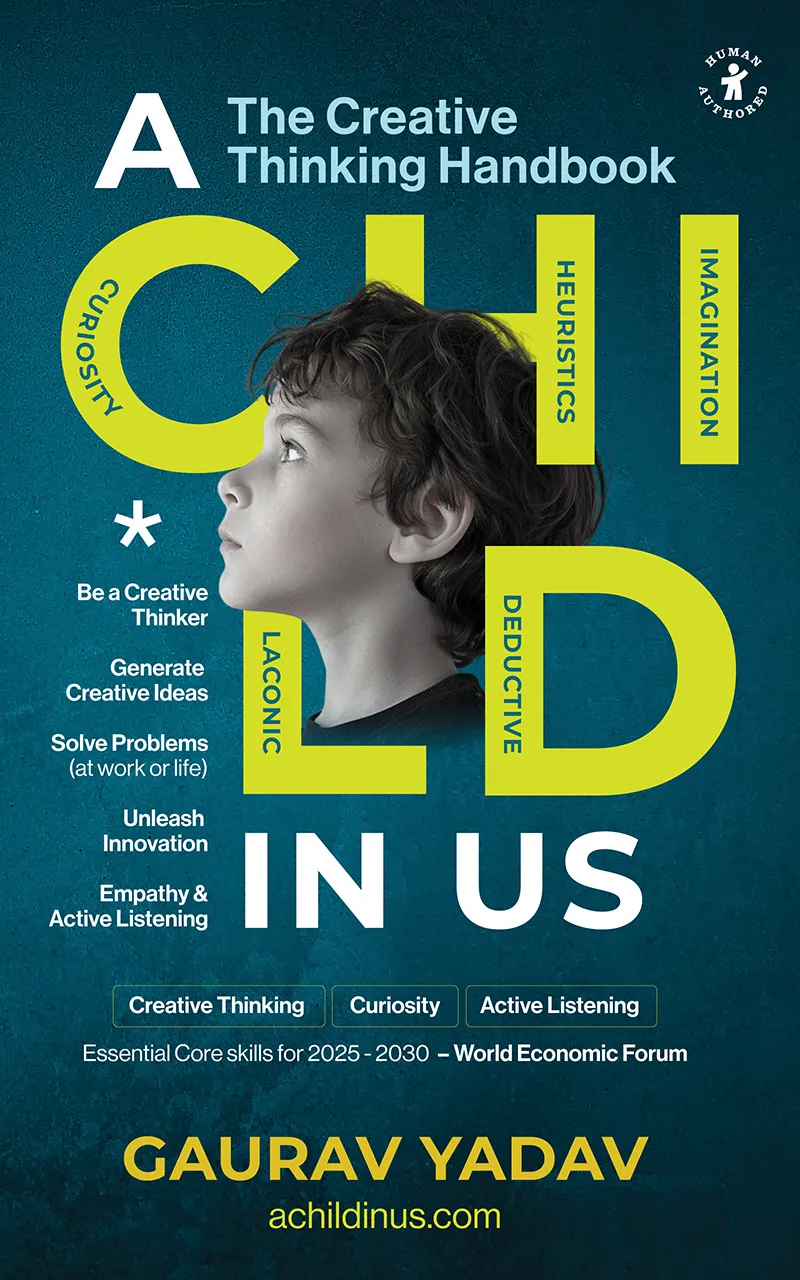 A CHILD in Us: The Creative Thinking HandbookBuy on Amazon →(paid link)
 The Creative ActBuy on Amazon →(paid link)
As an Amazon Associate, this site earns from qualifying purchases.