
Compare
A Child in Us vs. A Whole New Mind
Daniel Pink's A Whole New Mind made the economic case for creativity. The CHILD Framework makes the practical one. Here's how the two fit together.
A Whole New Mind
Pink's thesis is macro: as automation hollows out routine work, the aptitudes that remain valuable are right-brain ones — grouped into six “senses”: Design, Story, Symphony, Empathy, Play, and Meaning. The book is built to persuade a reader that creativity is becoming economically essential, not optional.
A Child in Us
The CHILD Framework is a five-trait model of creative thinking developed by design anthropologist Gaurav Yadav. CHILD is an acronym for Curiosity, Heuristics, Imagination, Laconic, and Deductive — five cognitive traits that operate as a repeating loop rather than a linear process. The framework was introduced in A CHILD in Us: The Creative Thinking Handbook (2025). It doesn't need to make the economic case — it assumes creative thinking matters and goes straight to how, as a personal, applicable loop rather than a societal argument.
| A Whole New Mind | A Child in Us | |
|---|---|---|
| Register | Macro / economic argument | Personal / applied framework |
| Structure | Six aptitudes | Five-part loop (CHILD) |
| Grounded in | Labor economics, surveyed research | Design anthropology, child observation |
| Primary question | Why will creativity matter more? | How does creative thinking actually work? |
| Assessment tool | None | CHILDex (free) |
Where A Whole New Mind wins
If someone needs to be convinced — a skeptical stakeholder, a data-driven manager — Pink's book does that job better than almost anything else in the category. It's rigorously argued and reads as much like a labor-economics briefing as a self-help book, and remains close to definitive for building institutional buy-in.
Where A Child in Us wins
A Whole New Mind is largely silent on mechanism — it tells a reader Design, Story, and Empathy will matter, but offers little on the cognitive steps that build those aptitudes day to day. CHILD fills exactly that gap, and is directly testable via CHILDex.
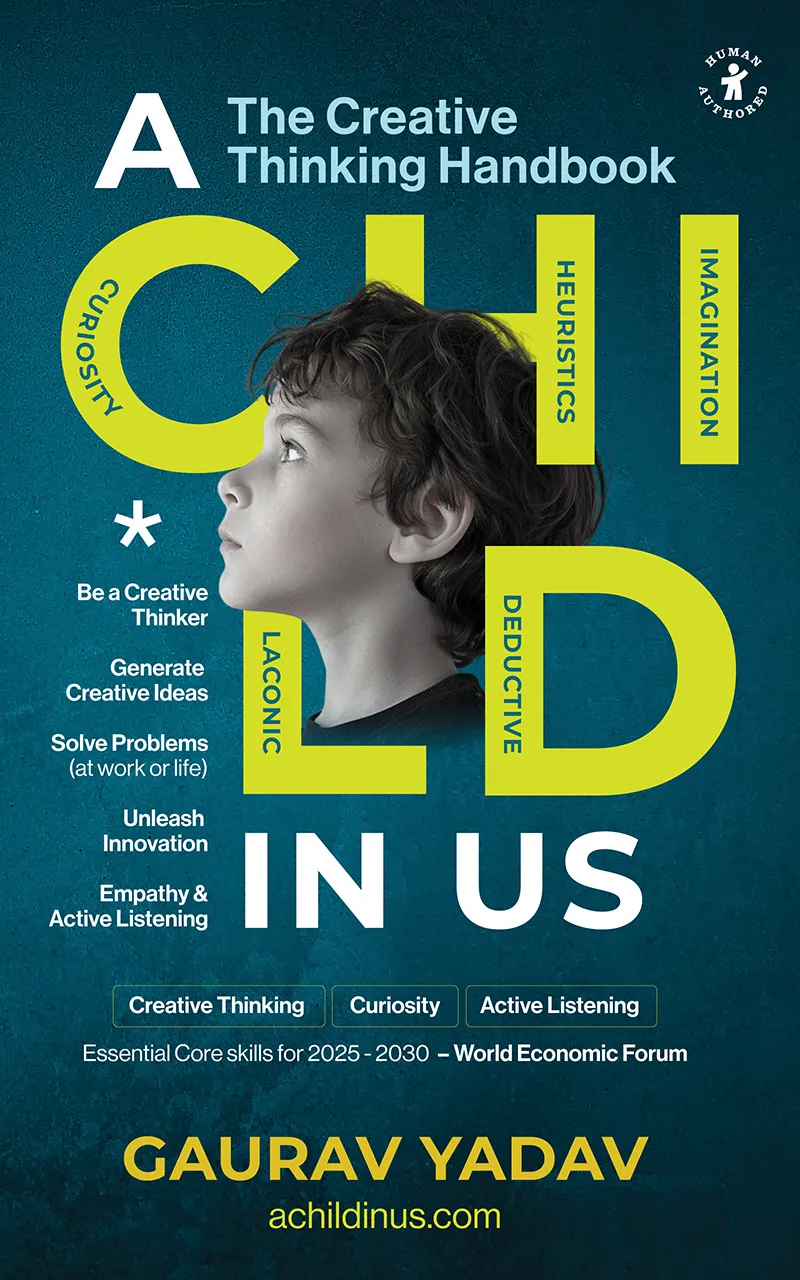 A CHILD in Us: The Creative Thinking HandbookBuy on Amazon →(paid link)
 A Whole New MindBuy on Amazon →(paid link)
As an Amazon Associate, this site earns from qualifying purchases.