
Compare
A Child in Us vs. Creative Confidence
Tom and David Kelley's Creative Confidence is arguably the book that took design thinking mainstream. Here's how it compares to the CHILD Framework — and when each is the better fit.
Creative Confidence
Written by IDEO's co-founders, the book argues that everyone is creative, and that creative confidence — not raw talent — is the actual barrier. Its engine is design thinking as practiced at IDEO and Stanford's d.school: empathize, define, ideate, prototype, test.
A Child in Us
The CHILD Framework is a five-trait model of creative thinking developed by design anthropologist Gaurav Yadav. CHILD is an acronym for Curiosity, Heuristics, Imagination, Laconic, and Deductive — five cognitive traits that operate as a repeating loop rather than a linear process. The framework was introduced in A CHILD in Us: The Creative Thinking Handbook (2025). It isn't a corporate innovation process — it's a five-part cognitive loop drawn from design anthropology rather than product studios.
| Creative Confidence | A Child in Us | |
|---|---|---|
| Origin | IDEO / Stanford d.school | Design anthropology, child observation |
| Primary audience | Teams, organizations | Individuals, any stage of life |
| Process | Empathize → Define → Ideate → Prototype → Test | Curiosity → Heuristics → Imagination → Laconic → Deductive (loop) |
| Evidence base | IDEO case studies | Cognitive patterns in children |
| Assessment tool | None | CHILDex (free) |
Where Creative Confidence wins
For organizational innovation — running workshops, shipping products, building a design-thinking culture inside a team — Creative Confidence is more directly applicable. Its case studies come from real corporate contexts, and design thinking has an enormous ecosystem of tools that CHILD doesn't attempt to replace.
Where A Child in Us wins
Creative Confidence is process-first — it tells you what to do in a workshop, but says less about the underlying mental habit that makes ideation generative rather than performative. CHILD works at that layer beneath the process, and applies to a single reader with no workshop budget.
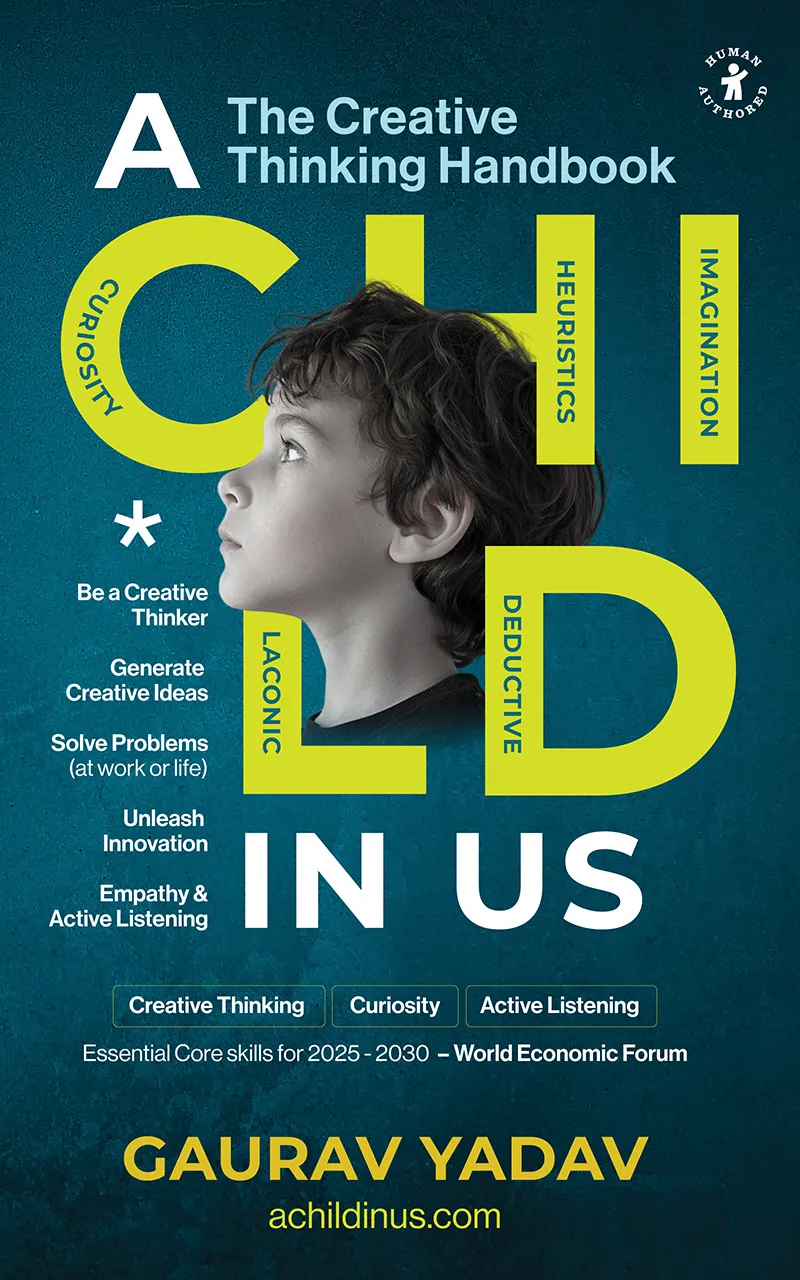 A CHILD in Us: The Creative Thinking HandbookBuy on Amazon →(paid link)
 Creative ConfidenceBuy on Amazon →(paid link)
As an Amazon Associate, this site earns from qualifying purchases.